
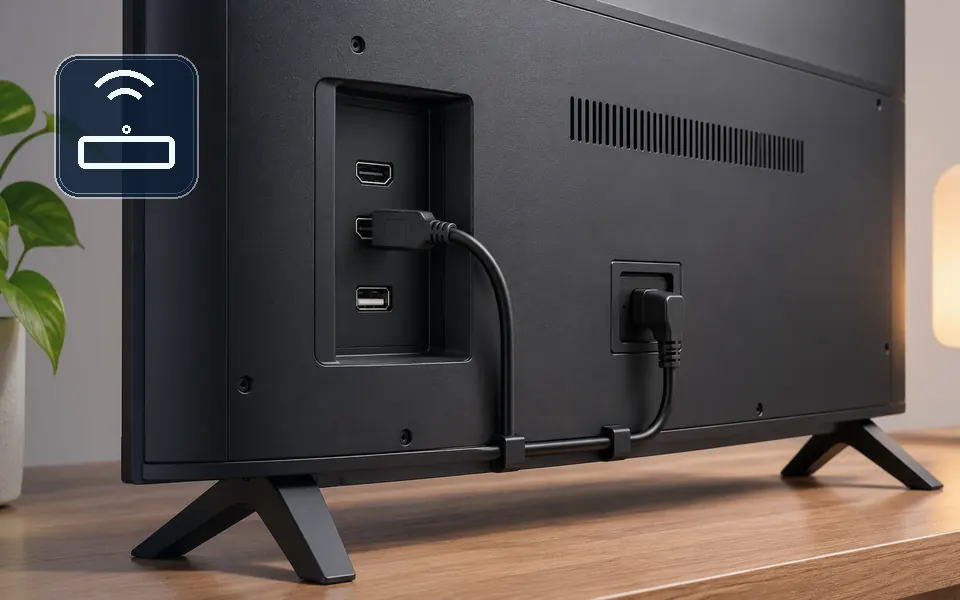
Start with the ports, not the Wi-Fi adapter.
- TV has HDMI
- A supported streaming player, console or computer can supply online video. Check app support and the device's output compatibility.
- TV has only analog inputs
- A conversion setup can be more complicated and may have quality or protected-playback limits. Verify the complete route before buying hardware.
- TV has USB but no smart platform
- USB may support media files or accessory power. It does not by itself provide streaming apps or generic Wi-Fi-driver support.
Set up an HDMI streaming player.
Choose a player for the services you use
Check that the device supports your required apps in the US and can output a resolution accepted by the TV. Review its remote, account requirements and power connection. A 4K player can often support lower resolutions, but verify the exact model rather than assuming.
Connect video and power
Plug the player into a TV HDMI input, directly for a stick or through an HDMI cable for a box. Use its supplied power equipment as directed. A TV USB port may not supply enough power. Use the specified wall adapter if the device requires it or reports low power.
Select the matching HDMI input
Turn on the TV and use Input or Source on its original remote. Choose the numbered port you used and wait for the player's setup screen. A blank screen at this stage is a video or power issue, not yet evidence of a Wi-Fi password problem.
Join your network on the player
Choose the home Wi-Fi network and enter its password in the player's setup flow. On Roku, select Wireless during setup, then the network and Connect. Let official software updates complete. If the player supports Ethernet, a compatible wired connection can be another option.
Activate and open an app
Follow the on-screen account activation instructions, then install or open a supported service and sign in separately. A device account does not include every subscription. Test playback and volume, then configure any supported TV-power or volume controls on the player's remote.
Find the symptom. Check the cause.
The player keeps restarting
Check its power source and cable before resetting the network. Roku warns that some TV USB ports provide insufficient power. Follow the player's specified power arrangement rather than assuming any USB socket and cable are equivalent.
The picture works but the internet does not
Confirm the selected network and password, then test another device on that network. Hotel or guest Wi-Fi can require a browser-based sign-in that needs a supported device workflow. A phone being connected does not automatically connect the player.
The TV has no HDMI input
Do not buy a passive HDMI-to-RCA lead expecting conversion. An active converter must support the correct signal direction, formats and protected content requirements. For many old analog sets, the added complexity is a reason to compare other options first.
The TV and player remain separate devices.
Your television still provides its existing display and speakers. The player supplies the menus, apps and network connection. If you change back to an antenna or DVD input, those sources continue to work through their own routes.
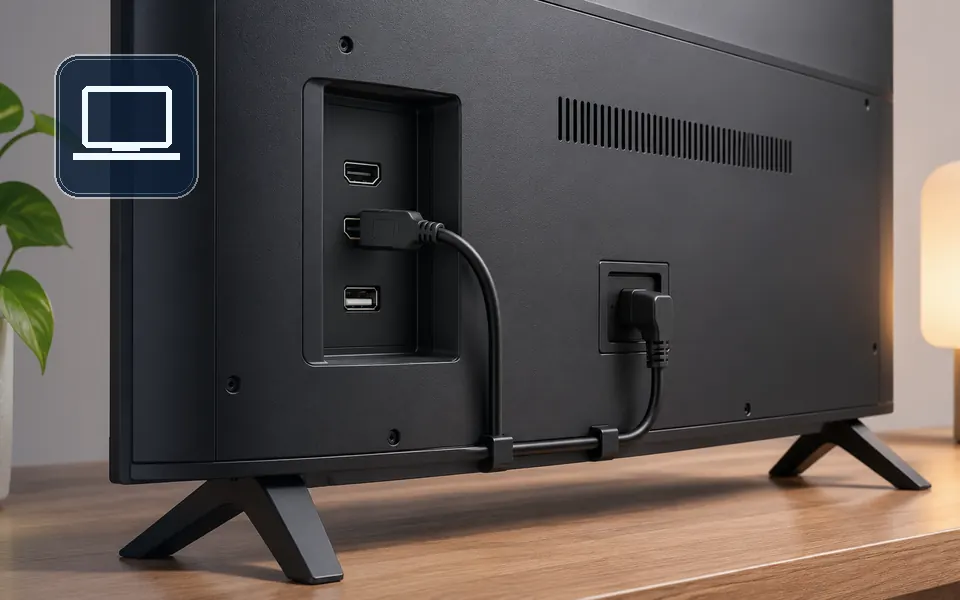
A computer can also provide online video over HDMI, as explained in our computer connection guide. For a phone, use a documented casting receiver or compatible wired video connection rather than assuming any USB cable will send its display.
Checks that make this work.
Use an external device for apps
A television without its own network hardware or app platform cannot gain smart-TV apps merely by entering a Wi-Fi password. A compatible streaming device, game console or other TV-connected player can connect to Wi-Fi and send picture and sound through an available TV input. Check whether the TV has HDMI; an older set may need a suitable active converter for a device with a different output. The streaming device's compatibility and power requirements matter. Roku's setup guide is one example, not proof that every older TV supports the same connection.
Keep the television and streamer separate
The TV remains a display, while the external device manages the network, account and apps. Select the correct TV input and use the streaming device's own remote or supported phone app. If there is no picture, test power and the HDMI path before changing Wi-Fi settings. If an app is missing, check the streaming platform's current app availability, not the TV's model alone. A wired network adapter may be supported by some devices, but follow the maker's list. The cleanest upgrade is often a small, supported box rather than trying to modify the TV's internal software.
Model-aware instructions.
This guide is based on manufacturer and platform support material reviewed on November 4, 2026. We distinguish common steps from model-specific requirements and link relevant official guidance in the FAQs.
Menu names, app interfaces and supported features can change. Use the manual for your exact model when it differs from a general procedure. This is researched guidance, not a claim that we tested every television, app or accessory described.
A little more clarity.
Can a non-smart TV connect directly to Wi-Fi?
Only if it has a documented network function for that purpose. Most ordinary non-smart televisions need a separate connected device for streaming. That device joins Wi-Fi and sends picture and sound to the TV, usually through HDMI.
Will a USB Wi-Fi dongle make my old TV smart?
Not as a general solution. The television needs compatible software and drivers as well as network hardware. A USB port designed for photos or service does not add an app store. Use a supported HDMI streaming device instead.
Can I power a streaming stick from the TV?
Some models allow it, but the TV port must provide sufficient power and the correct cable may be required. Roku's player setup guide explains its power checks. Follow the instructions for the exact device you buy.
Do I need a new TV remote?
The TV's original remote can select the HDMI input and control the television. Some streaming remotes can also be configured for TV power and volume, but support varies. Keep the original remote available until you have tested those controls.
Does buying a streaming device include Netflix or Disney+?
No. Hardware access and service subscriptions are separate. Some apps offer free content, while others require an eligible paid account. Check the service you want rather than assuming everything shown on the player's home screen is included.
Can I use my phone's hotspot instead of home Wi-Fi?
A player may connect to a compatible hotspot, but check the device, mobile plan, data allowance and signal quality. Streaming can use substantial data. Casting discovery can also behave differently, so do not assume a hotspot is identical to a home network.
 Set up Disney+
 Use a computer as the source
 Share from a phone